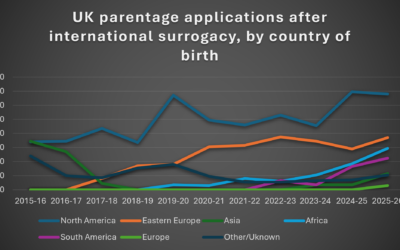


Following a number of problematic recent cases, the High Court has set out guidance all parents should follow before entering into a surrogacy arrangement overseas.
It was prompted by several problematic cases, the first two involving unethical multi-jurisdictional arrangements brokered from Northern Cyprus (Three High Court judgments warn of risky surrogacy practices in Cyprus and urge intended parents to exercise caution – NGA Law), and the last involving parents in their 70s who were unlikely to survive their children reaching adulthood. Mrs Justice Theis began with setting out 16 key issues to be considered by intended parents at the outset in RE Z (Foreign Surrogacy) and the list was adopted and added to, first by the President of the Family Division, Sir Andrew McFarlane, in Re Z (Unlawful Foreign Surrogacy) and then by Mrs Justice Knowles in Re B (Foreign Surrogacy: Welfare Issue: Ages of Applicants).
The judgments together set out 21 issues all intended parents should consider at an early stage to ensure the surrogacy arrangement they are planning is lawful, ethical and in their children’s best interests, with a clear warning from the court that those who deliberately do not follow this advice may be later refused a parental order. The list puts emphasis on early legal advice in each relevant jurisdiction, understanding the practical steps to be followed to get home, assessing the role of agencies critically, ensuring that the surrogate is being adequately informed and supported and understanding what the contact arrangements will be, keeping proper records and taking steps to ensure the welfare of the child.
Here are the High Court’s questions every intended parent through surrogacy should ask before going ahead:
(1) What is the relevant legal framework in the country where the surrogacy arrangement is due to take place and where the child is to be born? Put simply, is such an arrangement permitted in that country?
(2) When the child is born, will the intended parents be recognised as parents in that country, if so how? By operation of law or are the intended parents required to take some positive step and, if so, what steps need to be taken and when (pre or post birth)?
(3) What is the surrogate’s legal status regarding the child at birth?
(4) If the surrogate is married at the time of the embryo transfer and/or the child’s birth, what is the surrogate’s spouse’s legal status regarding the child at birth?
(5) If an agency is involved what role do they play in matching the surrogate with the intended parents?
(6) What information, preparation or support has the surrogate had about any proposed surrogacy arrangement?
(7) Does the surrogate speak and/or read English? If not, what arrangements are in place to enable her to understand any agreement signed?
(8) Will the intended parents and the surrogate meet and/or have contact before deciding whether to proceed with a surrogacy arrangement?
(9) When will the agreement between the intended parents and surrogate be made, before or after the embryo transfer, and what are the reasons for it being at that time?
(10) What arrangements are proposed for contact between the intended parents and the surrogate during the pregnancy and/or after the birth? For example, is it only via the agency or can there be direct contact between the intended parents and the surrogate?
(11) In which jurisdiction will the embryo transfer take place and in which jurisdiction will the surrogate live during any pregnancy?
(12) Can the jurisdiction where the child is to be born be changed at any stage and, if so, by whom and in what circumstances?
(13) What nationality will the child have at birth?
(14) Following the birth of the child, what steps need to be taken for the child to travel to the United Kingdom? What steps need to be taken to secure any necessary travel documentation for the child and how long does that take?
(15) Will the intended parents need to take any separate immigration advice to secure the child’s travel to the United Kingdom and what is the child status once the child has arrived in this jurisdiction?
(16) Keeping a clear and chronological account of events and relevant documents is not only important for the purposes of a parental order application but also, importantly, retains key information regarding the child’s background and identity.
(17) Parties should consider early and meaningful engagement with either or all of HD, DfE and/or DHSC (depending on what the particular issues which have arisen are and bearing in mind the different responsibilities of each), especially where there are, or there are intimated proceedings, in some court or tribunal (for example, the First-tier Tribunal (Immigration and Asylum Chamber));
(18) In particular, if proceedings are issued in the Family Court, early consideration should be given to the addition of either or all of HD, DfE and/or DHSC (again depending on what the particular issues which have arisen are and bearing in mind the different responsibilities of each) as a party;
(19) What steps have been taken by the intended parents in relation to estate planning (before and after a parental order is made) in respect of the child’s future welfare?
(20) What steps have been taken by the intended parents in respect of future care and financial arrangements for the child in the event of the incapacity of one (or both) of the intended parents?
(21) What steps have been taken by the intended parents in respect of future care and financial arrangements for the child in the event of the death of one (or both) of the intended parents?
We have worked with intended parents planning international surrogacy arrangements for nearly 20 years, and see an enormously broad range of experience. In most jurisdictions the answers to these questions are clear and obvious from the start, particularly where there is an established legal framework supporting ethical surrogacy. However, the past few years have seen an upswing of new surrogacy options, including in jurisdictions where there is no clear legal framework or established track record (e.g. in Mexico and Colombia), arrangements which involve anonymous surrogates (e.g. in Africa) and cases which involve highly problematic arrangements with travelling surrogates (between Northern Cyprus, Georgia, Ukraine, Uzbekistan, Kazakhstan, Kyrgyzstan, Armenia etc). While not the norm for surrogacy, such arrangements are legally and ethically problematic, and great care is needed. It is always important for intended parents to think critically about where their information is coming from, and to be careful about relying on assurances from agencies that ‘everything will be fine’ or ‘this is how things are done’ without questioning obviously dubious practices or verifying basic information about what will happen. Taking legal advice – in both the UK and the country in question – can be critical in unpicking reality from sales pitches, since lawyers are there to safeguard the interests of their clients, but it is also important for parents to apply a critical mind and do as much wider research as possible.
If you are planning to build your family through surrogacy, the onus is on you to get this right for you and your children to make sure that everyone is protected and you are entering into an ethical arrangement in an informed way. The High Court has now made that crystal clear.
By Kelly Blaxall

The UK’s leading surrogacy lawyers
Find out more about how we support families through surrogacy